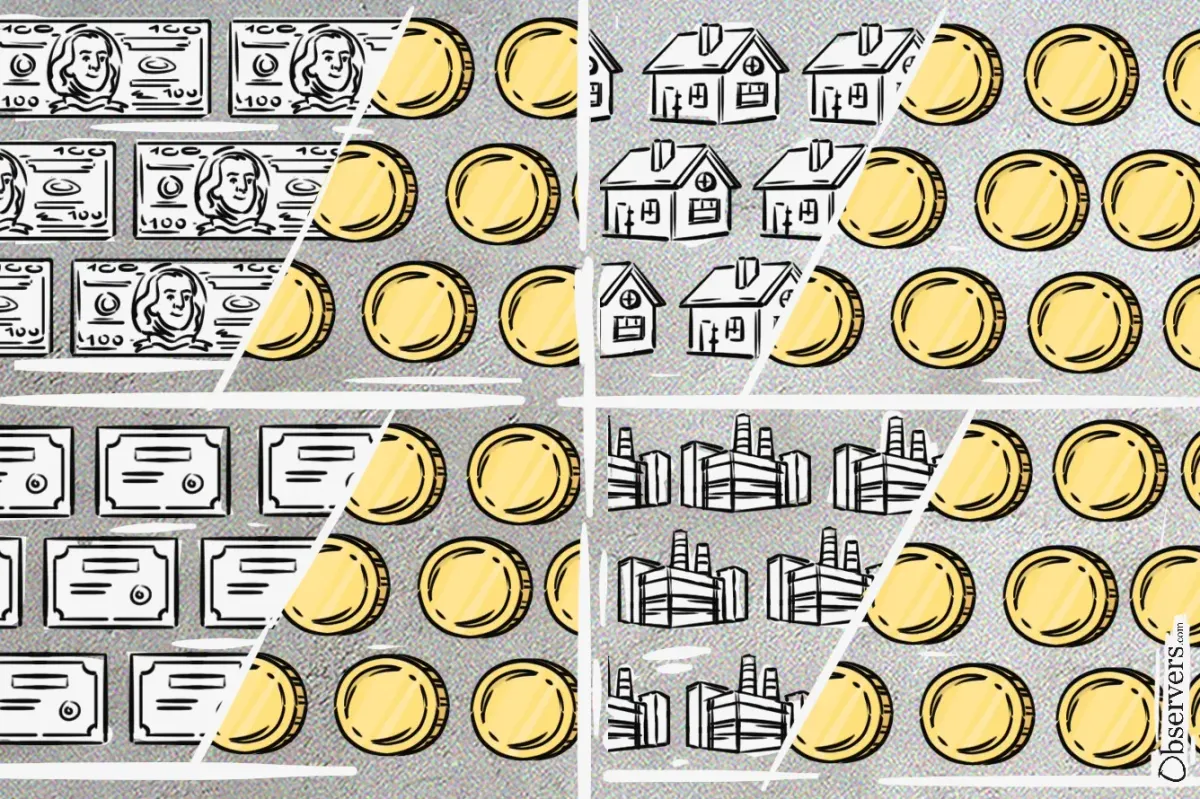
Tokenizing "everything" has long served as the crypto industry’s premier institutional narrative. The original cypherpunk vision—that decentralized cryptography would displace sovereign fiat money—ran into the stubborn reality of global monetary policy, sticky user habits, and macroeconomic gravity. Yet, while the technology failed to replace money, it achieved something else: it demonstrated what continuous, programmable, and counterparty-agnostic settlement of digital assets could look like in practice.

Between speculative frenzies, outright scams, and genuine engineering breakthroughs, crypto inadvertently built an entirely parallel market infrastructure. It is this infrastructure—not the ideological revolt against central banking—that finally seized the undivided attention of traditional finance.

In conventional finance, moving an asset involves updating isolated, siloed databases maintained by disparate intermediaries (custodians, broker-dealers, clearinghouses, transfer agents). Reconciling these records takes days (T+1 or legacy T+2) and introduces counterparty and settlement risks. A blockchain replaces fragmented databases with a single, synchronized state machine. When an asset is represented as an on-chain token, ownership transfer and execution occur atomically (Delivery-versus-Payment): the asset and payment legs either clear simultaneously or fail entirely, eliminating reconciliation friction and pre-funding requirements.

The Physical Asset Mirage vs. The Financial Native

The Real-World Asset (RWA) narrative initially promised to tokenize everything under the sun: Manhattan commercial real estate, fine art, shipping containers, and physical gold. In the physical realm, this model collapsed under legal reality.

A token representing a fractional deed to an apartment building faces an immutable flaw: the blockchain cannot enforce physical eviction, maintenance obligations, or sovereign property rights. If an on-chain wallet transfers a real estate token to another party, but an off-chain tenant refuses to pay rent or a municipal land registry disputes the transfer, the on-chain state change is practically meaningless. True legal finality exists off-chain, backed by courts, bailiffs, and paper registries. The blockchain ledger merely introduces an extra layer of operational overhead without removing the real-world principal.

Financial assets, however, are fundamentally different. Stocks, bonds, repo contracts, and cash are not physical objects; they are abstract legal claims recorded in ledgers. They are digital natives trapped in off-chain architectures. Bringing them on-chain does not require reconciling physical reality with digital state; it simply requires migrating existing off-chain books and records to a programmable, shared ledger.

The Reality of RWA: Treasuries, Stablecoins, and More Treasuries

Despite years of grandiose pitches, the logical next step—direct, native on-chain corporate issuance—never materialized at scale.

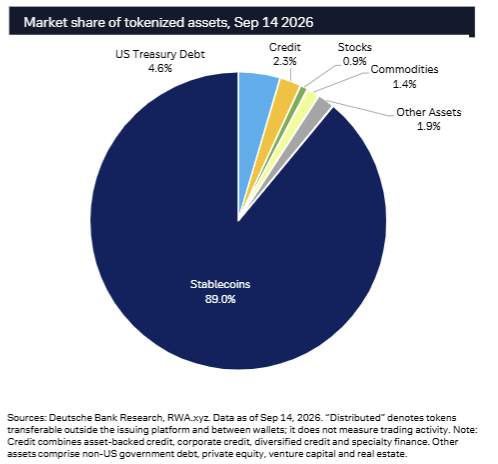
If you strip away the marketing, current RWA metrics reveal a striking concentration:

  1. The Stablecoin Dominance (~90%+): The vast majority of "real-world value" on public blockchains is not tokenized equity or corporate credit, but private digital representations of fiat—chiefly USDT and USDC.
  2. The T-Bill Redundancy: Where are those stablecoins backed? In short-term U.S. Treasury bills and overnight bank repo.
  3. Institutional "Yield" Tokens: The fastest-growing non-stablecoin category (including BlackRock’s BUIDL, Franklin Templeton’s FOBXX, and Ondo’s offerings) consists almost entirely of tokenized U.S. Treasuries and cash-equivalent money market funds.

The paradox is hard to miss: we have tokenized the safest, most liquid sovereign debt instrument in human history several times over, while equity and corporate debt remain almost completely untouched. In the first layer, stablecoin issuers take investor dollars, buy off-chain Treasuries, and issue tokens. In the second layer, asset managers tokenize the Treasuries directly to serve as collateral inside DeFi. Rather than diversifying global capital onto public rails, tokenization has effectively acted as a conduit for exporting short-term U.S. sovereign debt into the digital asset ecosystem.

Why Can't a U.S. Company Simply Issue Stock on Ethereum?

If financial assets are just digital ledger entries, why hasn't an average Nasdaq or NYSE company issued native shares straight onto Ethereum, unlocking global, 24/7 liquidity?

In February, an essential legal barrier seemed to fall when SEC guidance established that distributed ledger technology could legally serve as an issuer’s official securityholder registry. Companies like Galaxy Digital and Exodus demonstrated native on-chain cap tables, while Securitize and DTC built compliant rails.

Yet structural roadblocks remain:

  • The Transfer Agent & Recovery Dilemma: State corporate law (such as Delaware General Corporation Law § 224) and federal securities regulations mandate that an issuer must be able to recover stolen shares, comply with court-ordered freezes, and resolve lost private keys. Pure, immutable ERC-20 tokens cannot satisfy this requirement without administrative master keys that compromise decentralization.
  • Regulation NMS & Market Fragmentation: Under U.S. National Market System rules, broker-dealers owe customers a strict duty of Best Execution, bound by the Order Protection Rule (Rule 611). If a stock trades simultaneously on the NYSE limit order book and an on-chain automated market maker (AMM), how does a broker route orders when gas volatility, block times, and Maximal Extractable Value (MEV) create structural latency and execution slippage?

The SEC’s September 17 framework opens the door to DeFi execution mechanisms (AMMs), but it wraps them in conventional investor-protection boundaries. The technology is permitted, but only on the condition that it acts like the legacy market.

The five-year conditional Innovation Exemption carved out qualified Tokenized Securities Venues (TSVs) from statutory "Exchange" and "Dealer" definitions, granting them regulatory room to operate AMMs and liquidity pools. In an intriguing nod to open-source architecture, the framework mandates that these smart contracts remain public, auditable, and anchored to a public, permissionless blockchain.

Yet this technical opening comes bundled with operational safeguards that keep mainstream adoption on a tight leash: TSVs cannot unilaterally list tokenized equities; they must provide public companies 30 days’ advance notice, leaving issuers with an absolute veto to shut down secondary trading. Furthermore, the permissionless base layer is strictly insulated from DeFi’s open composability: pseudonymous participation is barred in favor of whitelisted KYC/AML access controls, and smart contract pools are obligated to mirror off-chain market safeguards, halting execution instantly whenever trading halts on primary venues like Nasdaq.

The European Settlement Obsession: Pontes vs. Dollar Liquidity

While the U.S. leans into tokenized collateral and private stablecoin liquidity, Europe has tackled what it considers the foundational problem: the cash leg of settlement.

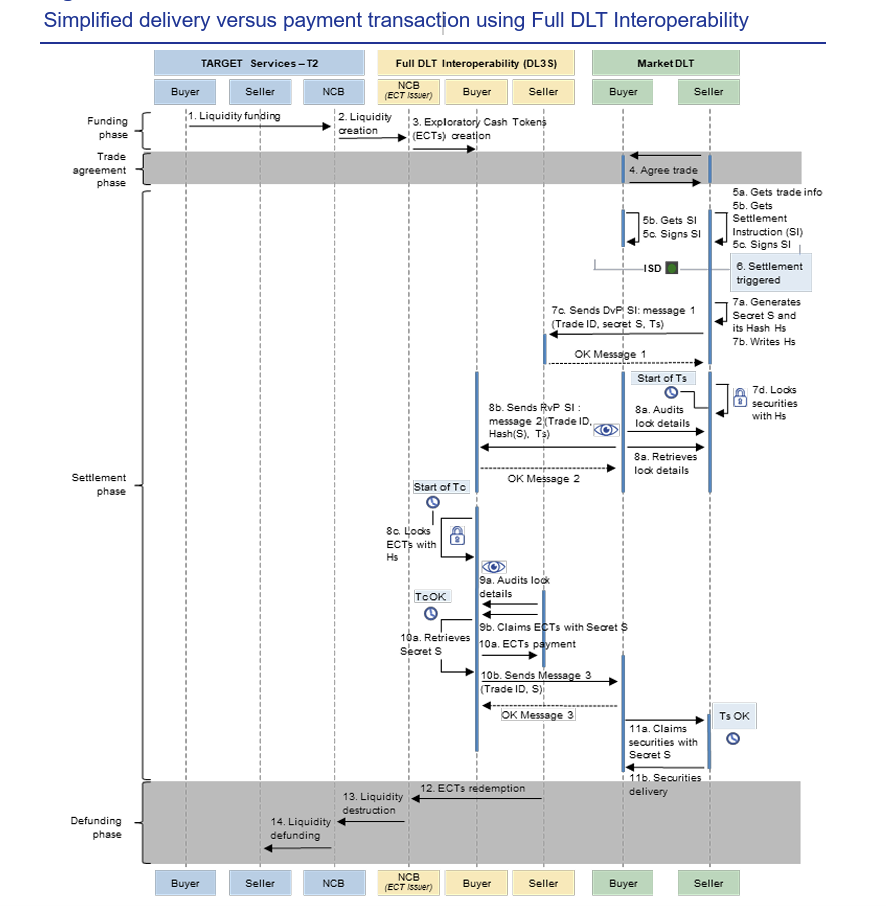
On September 21, the Eurosystem launched Pontes, a framework that consolidates three disparate national central bank experiments (the Deutsche Bundesbank Trigger solution, the Banca d'Italia TIPS Hash-link, and the Banque de France wholesale CBDC) into an operational rail. Pontes links external market DLTs directly to central bank money held in TARGET Services.

Any two architectures can be patched together given enough engineering resolve. The resulting sequence diagram for one of Pontes routes speaks for itself:

Pontes using the full DLT Interoperability solution, provided by the Banque de France. Source: ECB

In the crypto ecosystem, this obsession with building a specialized settlement mechanism seems alien. On-chain, everything is already settlement. When an AMM executes a swap between ETH, USDC, or tokenized assets, execution and final settlement happen in the exact same block. Why spend years engineering multi-layer bridges to wholesale central bank money?

The institutional answer lies in credit and systemic risk:

  • The Commercial Money Discount: Crypto relies on private stablecoins (USDC/USDT) or tokenized deposits. Under Basel standards and central bank frameworks, commercial bank money carries issuer default risk. If a stablecoin issuer depegs or a commercial bank fails, the settlement leg fails.
  • Zero Credit Risk: Central-bank money is the risk-free anchor of the financial system. For institutional trades measured in billions, banks cannot accept private counterparty exposure simply to achieve atomic settlement.

Europe chose regulatory purity over market speed, building intricate interoperability gateways to avoid private stablecoin settlement. The U.S., by contrast, prioritized market-driven stablecoin liquidity, opting to clean up the regulatory architecture after adoption had already taken root.

The Infrastructure Layer: Between Giant Pilots and Reality

The rest of the traditional financial plumbing is moving rapidly to secure its relevance:

  • Swift’s Shared Ledger: Presented during Sibos in Miami, Swift's multi-bank initiative orchestrates cross-border transactions using tokenized deposits. Yet the operational hurdle is substantial. As Taurus co-founder Lamine Brahimi observed, banks cannot simply plug into a unified network; they must first build their own internal permissioned ledgers, custody key-management infrastructure, and smart-contract auditing capabilities. Connecting to an external ledger without internal capabilities turns the institution into a fragile pass-through.
  • DTCC’s Tokenization Service: Scheduled for production launch this month, DTCC is bridging securities held inside DTC infrastructure onto DLT without altering existing custody or legal frameworks. The limitation? It is a digital twin model: an off-chain ledger creating an on-chain shadow, introducing double-entry synchronization risks across platforms.

The Hybrid Reality: Permissionless Rails Carrying Permissioned Finance

The emerging market structure is defined by a central tension: institutions want the operational efficiencies of distributed ledgers without their governance implications.

Traditional finance is picking and choosing blockchain properties like an à la carte menu:

  • They demand Atomic Settlement, but refuse transaction irreversibility; they require court-ordered clawbacks and emergency circuit breakers.
  • They embrace Programmability and AMM liquidity pools, but reject autonomous agents; someone with a balance sheet, compliance department, and legal liability must take responsibility for the smart contract.
  • They utilize Public Ledgers for universal settlement, but enforce strict whitelist-gating on every transacting wallet address.
  • They appreciate Collateral Mobility, but demand legal finality that remains anchored to bankruptcy codes and domestic jurisdiction rather than cryptographic consensus.

The result is a distinct compromise: permissionless rails carrying permissioned financial assets. The base network demands no clearance to run a node, audit state, or verify consensus, but every interaction on the financial layer above remains strictly answerable to legacy rules.

The original cypherpunk proposition of eliminating central intermediaries has been turned inside out. Rather than disintermediating capital markets, institutions are absorbing the cryptographic plumbing—shared ledgers, atomic DvP, algorithmic liquidity pools—to reinforce their own operational mandates.

Whether this represents a permanent equilibrium or merely an opening act for deeper decentralization at the edges of the financial layer remains to be Observed.

Share this article
The link has been copied!