Having morals in crypto is expensive. This opening quote from the whitepaper of Ethos Network sets the stage for an on-chain reputation market.

Fraud, grift, and rug pulls continue to extract time and money, proving that crypto’s biggest bottleneck is not scaling or UX—it is trust.
Ethos officially launched its on-chain reputation system in January 2025 on Base. Conceived in early 2024 by Trevor Thompson (aka Serpin Taxt) and Ben Walther, their premise was straightforward: the crypto industry has an almost unlimited market for credibility verification. Ethos’ answer is to make credibility measurable, stakeable, and tradable.
Ethos is a layered system that combines gamified participation, economic signaling, and identity integration into one credibility engine. At the visible level, Ethos feels almost like a Web3-native social game with a minimalistic pixel-style design, X (formerly Twitter) user profiles, and intuitive upvotes and downvotes.
Ethos Participation and Reviews
The basic action is leaving positive, neutral, or negative reviews. Participation on the platform is gamified. Users earn XP (experience points) for leaving reviews as well as for upvoting or downvoting existing ones. There is also XP for daily “contribute” prompts about other profiles and for maintaining streaks of participation.
Leaderboards display top contributors and the most credible accounts, reinforcing visibility and competition. XP influences weight inside the system; over time, consistent participation compounds influence. All of this creates a subtle but powerful incentive structure: reputation on Ethos is not only something you trade—it is something you actively help shape.
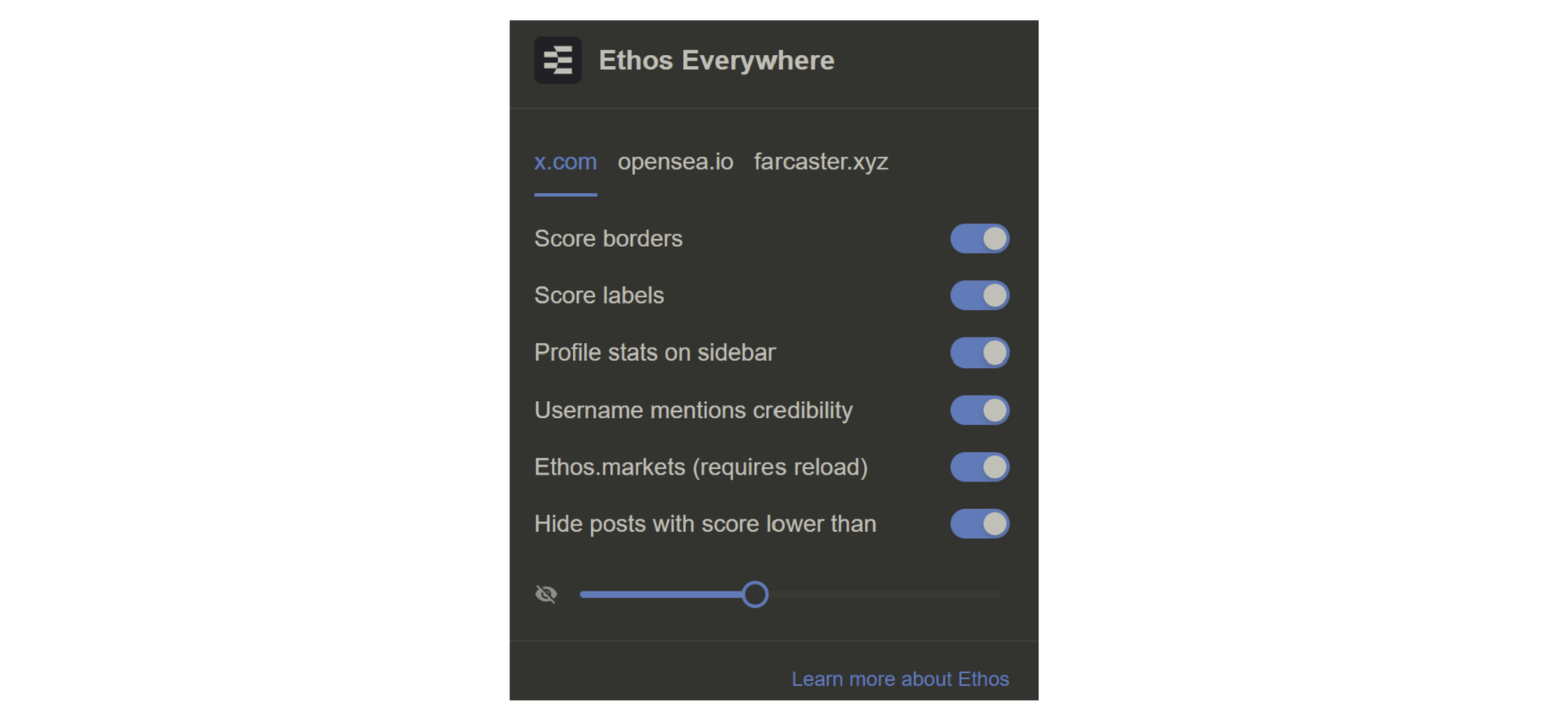
Importantly, Ethos does not attempt to build a new social graph. Instead, it utilizes X, where the most active industry community lives. Reviews can be written from within X, and timeline browsing shows credibility scores inline. Ethos also features the "Ethos Everywhere" browser extension, which has seen widespread adoption. It transforms the platform from an isolated directory into an active overlay that ranks profiles across X, OpenSea, Farcaster, and even Kaito leaderboards.

Without any review, the badge shows a neutral grey 1200 score. Other scores are: 0-799 - untrusted, 800-1199 - questionable, 1200-1599 - neutral, 1600-1999 - reputable, and 2000-2800 - exemplary.
The Founders' most trusted leaderboard looks like this at the time of writing:

Vouching and Slashing: The Market Core
Beneath this gamified interface sits the core economic layer. Users can financially express trust through two actions:
- Vouching: Staking ETH in support of someone’s credibility.
- Slashing: Economically signaling a loss of trust. Slashing initiates a 48-hour community vote where the accuser must lock a deposit. If the community votes that the accuser is wrong, the accuser loses their points and staked funds.
The Financialization of Trust The pricing mechanism for the Ethos Reputation Market follows an LMSR-style design (Logarithmic Market Scoring Rule), a similar class of automated market maker (AMM) used in prediction markets like Polymarket. By applying this to human credibility, Ethos is essentially financializing trust. Users trade "trust" or "distrust", turning social consensus into a tradable derivative.
With an LMSR-type AMM:
- Early reputation shifts are relatively inexpensive.
- Large moves become progressively more costly.
- Liquidity is algorithmically ensured.
Real-world usage suggests that vouch size on Ethos does not linearly amplify influence. Score impact appears to reflect a combination of capital commitment, the credibility of the voucher, and historical XP. Ethos is therefore economically anchored, but not purely capital-dominated.
Sybil Protection and The Reality Check
Collecting Voux Populi is not an easy task, even with proper economic incentives and perfectly designed math formulas. Public platforms are prone to manipulation by whale capital, insider trading, and hostile behavior.
Ethos restricts active participation through an invite system. Invites are not neutral tokens; they carry bonding risk. If you invite someone, you are linked to them for 90 days. If their credibility rises, yours benefits. If their credibility collapses, you are penalized. Inviting someone becomes a form of underwriting, creating a web-of-trust dynamic.
While this 90-day invite bond is clever, it presents a fascinating reality check. If the financial upside of a rug-pull exceeds the cost of purchasing enough "trusted" invites and faking vouches, the system can still be gamed.
At the same time, overly strict policies risk turning Ethos into a closed club—much like certain gated subreddits—where established groups monopolize opinions, effectively shutting out new users and dissenting ideas.
The One Year of Ethos
After one year live, Ethos has solidified its footprint. By early 2026, the protocol secured a Total Value Locked (TVL) of approximately $1.78M on the Base network, predominantly held within Vouch contracts.
This growth perfectly aligns with a broader structural shift in crypto:
- Prediction markets are resurging, especially during political and macro cycles.
- Speculation culture has normalized.
- The Rise of InfoFi and AI: As autonomous AI agents begin executing financial strategies on decentralized exchanges or platforms, they require verifiable on-chain identities. Ethos provides the infrastructure needed for these agents to build social capital and prove their reliability, acting as an essential filter against malicious bots.
In June 2025, the Ethos slashing mechanism proved its teeth during a high-profile identity fraud incident.
A founder associated with Humanity Protocol was caught utilizing someone else's face for verification purposes. Because real ETH and reputation were on the line, the Ethos community initiated a successful slashing event.
Exposing identity fraud committed by a project dedicated to 'Proof of Humanity'—right before its Token Generation Event (TGE)—speaks volumes about why the crypto industry needs Ethos. This incident proved that decentralized social slashing can successfully enforce real-world accountability, even against well-funded major actors.
Today, the protocol's official X account still shows a dismal Ethos credibility score of just 90, and the project tops the "least credible" list on the platform's leaderboard.

A possible opportunity for Ethos lies in decentralized finance. If an on-chain credit score is backed by staked ETH, historical reliability, and community consensus, lending protocols could leverage Ethos scores to offer better capital efficiency.
By bridging the gap between social capital and DeFi, Ethos has the potential to be used in much-discussed undercollateralized on-chain lending.
Looking ahead, the true endgame for any project like Ethos is mass adoption—achieving a level of volume and coverage that cannot be overturned by even the largest capital in the world. Getting to that scale will take time. Until then, our editorial team looks forward to securing an Ethos invite so we can continue our observations directly from the inside.